Sep 15, 20261 views
AI Agents Are Moving Into the SDLC — Now Comes the Hard Part: Governing Them
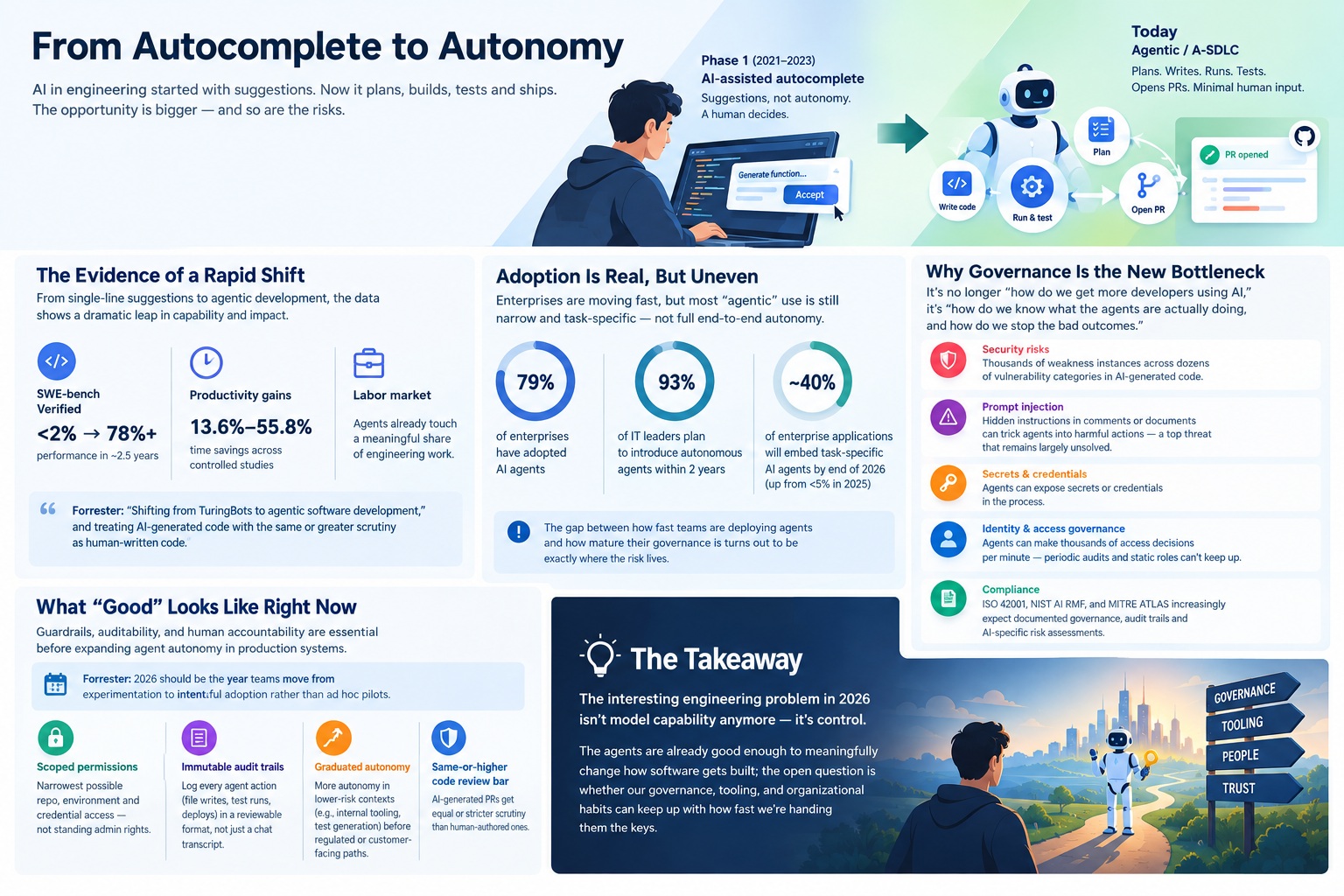
From Autocomplete to Autonomy
For a couple of years, "AI in engineering" mostly meant Copilot-style suggestions: a model proposes the next line or function, and a human decides whether to accept it. That phase had implicit governance built in — every suggestion required a human click. Researchers describing the evolution of AI-assisted development note this Phase 1 — AI-assisted autocomplete (2021–2023) era, where tools like GitHub Copilot and TabNine offered single-line or function-level completions inside human-directed workflows.
We're well past that now. The industry has moved to what Forrester and others are calling an agentic or "A-SDLC" model, where agents don't just suggest code — they plan tasks, write and run code, execute tests, and open pull requests with minimal human intervention at each step. One academic survey summarizing this shift points to striking empirical numbers: performance on SWE-bench Verified has gone from under 2% to over 78% in roughly two and a half years, alongside measured productivity gains of "13.6%–55.8% time savings across controlled studies" and labor-market data showing agents already touching a meaningful share of engineering work.
Forrester frames the current moment bluntly: organizations are "shifting from TuringBots to agentic software development" and increasingly treating AI-generated code with the same or greater scrutiny as human-written code.
Adoption Is Real, But Uneven
Enterprise adoption numbers back this up. One survey cited by industry analysts found that 79% of enterprises say they've adopted AI agents, and 93% of IT leaders plan to introduce autonomous agents within two years. Gartner's own projection is that roughly 40% of enterprise applications will embed task-specific AI agents by the end of 2026, up from under 5% in 2025.
But adoption numbers need context — most of what's counted as "agentic" today is still narrow, task-specific automation rather than fully autonomous end-to-end delivery. The gap between how fast teams are deploying agents and how mature their governance is turns out to be exactly where the risk lives.
Why Governance Is the New Bottleneck
This is the part that's changed the conversation on engineering teams I talk to. It's no longer "how do we get more developers using AI," it's "how do we know what the agents are actually doing, and how do we stop the bad outcomes."
The security picture is sobering. A 2025 study analyzing AI-generated code found thousands of weakness instances across dozens of distinct vulnerability categories in files pulled from public repositories. As one security analysis put it, agents that can write, run, and push code on their own create fundamentally bigger risks than simple suggestion tools — prompt injection, where hidden instructions embedded in comments or documents trick an agent into taking harmful actions, is described as a top threat that remains largely unsolved, and agents can also expose secrets or credentials in the process.
Identity and access governance experts are pushing a related point: traditional review cadences don't work for agents. Because agents can make thousands of access decisions per minute, periodic audits and static role assignments simply can't keep pace with that volume or speed — governance has to become a runtime concern, not a quarterly checklist item.
Compliance frameworks are scrambling to catch up too, with standards like ISO 42001, NIST's AI Risk Management Framework, and MITRE ATLAS increasingly expected to require documented governance, audit trails, and risk assessments specific to AI systems.
What "Good" Looks Like Right Now
Forrester's advice to CIOs and engineering leaders captures where the industry consensus is landing: guardrails, auditability, and clear human accountability are essential before expanding agent autonomy in production systems, and 2026 should be the year teams move from experimentation to intentful adoption rather than ad hoc pilots.
In practice, that means a few concrete things for teams actually running these systems day to day:
- Scoped permissions over blanket access. Agents should get the narrowest possible set of repo, environment, and credential access needed for a task — not standing admin rights.
- Immutable audit trails. Every agent action — file writes, test runs, deploys — needs to be logged in a way that's reviewable after the fact, not just visible in a chat transcript.
- Graduated autonomy. Rather than an all-or-nothing switch, teams are experimenting with tiers of oversight — agents earn more autonomy in lower-risk contexts (internal tooling, test generation) before being trusted in regulated or customer-facing paths.
- Same-or-higher code review bar. AI-generated pull requests are increasingly held to equal or stricter scrutiny than human-authored ones, not a lighter touch.
The Takeaway
The interesting engineering problem in 2026 isn't model capability anymore — it's control. The agents are already good enough to meaningfully change how software gets built; the open question is whether our governance, tooling, and organizational habits can keep up with how fast we're handing them the keys.