Sep 10, 202612 views
AI Coding Assistants Have Officially Gone Mainstream
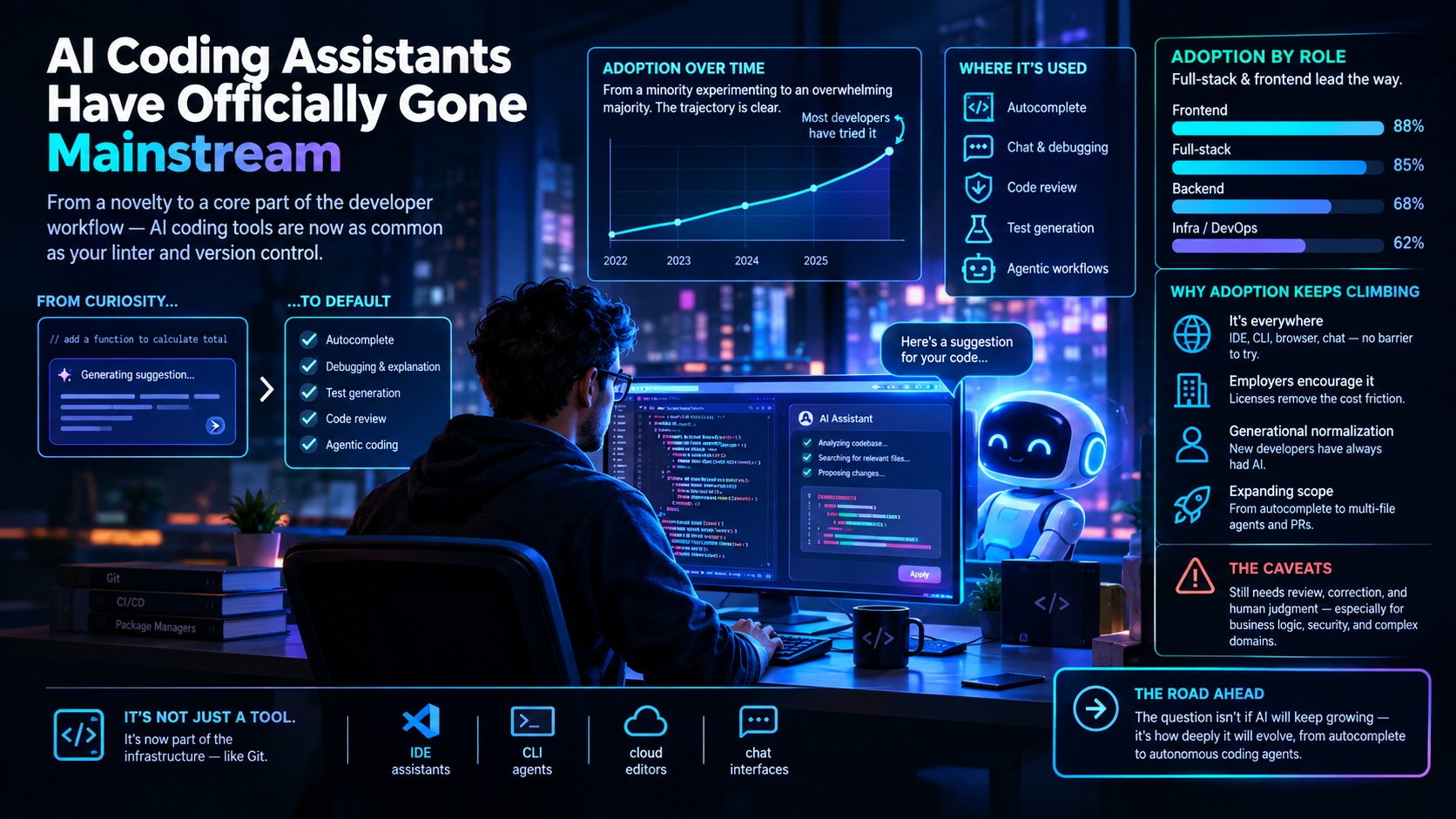
A few years ago, using an AI code generator felt like showing off a party trick. You'd type a comment, watch a suggestion pop up, and either marvel at it or laugh at how wrong it was. That novelty phase is over. Based on the last few cycles of major developer surveys, most professional programmers have now tried an AI coding tool, and a large share use one regularly. This isn't a niche behavior anymore—it's baseline tooling, sitting next to your linter and your version control system.
From Curiosity to Default Workflow
The trajectory is the important part. Adoption numbers have climbed year over year in things like the Stack Overflow Developer Survey, moving from "a minority experimenting" to "an overwhelming majority have tried it." What used to be framed as a question of if developers would adopt AI assistance has turned into a question of how deeply it's integrated into daily work—autocomplete-style suggestions, chat-based debugging, test generation, code review assistance, and increasingly, multi-step agentic coding that can open files, run commands, and iterate on its own.
The shift mirrors what happened with other once-optional tools that became infrastructure: version control, CI pipelines, package managers. Nobody debates whether to use Git anymore. AI assistants are heading in that direction fast, at least for writing and scaffolding code, even if trust in the output still varies a lot by task.
Who's Leading the Charge
The adoption curve isn't uniform across the industry, and that's one of the more interesting parts of the story. Full-stack and frontend developers consistently show up as the earliest and heaviest adopters. A few reasons make intuitive sense here:
- Volume of boilerplate. Frontend work is full of repetitive patterns—component scaffolding, form handling, styling, API wiring—exactly the kind of pattern-matching task where large language models shine.
- Fast feedback loops. Web development lets you see results immediately in a browser, which makes it easier to trust (or quickly discard) an AI suggestion.
- Ecosystem maturity. JavaScript/TypeScript has an enormous public training corpus, so assistants tend to be unusually strong in this stack, which reinforces adoption.
Backend-heavy and infrastructure-focused engineers tend to lag slightly, often citing concerns about correctness in performance-critical or security-sensitive code, and a general reluctance to hand off logic they can't easily verify at a glance. That gap seems to be narrowing as tools get better at reasoning over larger codebases and multi-file context, but it hasn't disappeared.
Why the Numbers Keep Climbing
A few forces are compounding adoption at once:
- Tooling is everywhere now. IDE-native assistants, CLI agents, browser-based coding environments, and chat interfaces mean there's no longer a meaningful barrier to trying one.
- Employer encouragement. Many engineering orgs now actively provide licenses for tools like GitHub Copilot or similar assistants, which removes the "should I pay for this" friction entirely.
- Generational normalization. Developers entering the field now have essentially never coded without an assistant available, so for them there's no "adoption decision" to make at all—it's just how you write code.
- Expanding scope. Early tools mostly autocompleted single lines. Now assistants handle multi-file refactors, generate tests, explain unfamiliar codebases, and open pull requests. Each new capability pulls in developers who weren't sold on the previous generation.
The Caveats Worth Remembering
Mainstream adoption of trying a tool is not the same as blind trust in its output. Plenty of developers who use AI assistants daily still report needing to review, correct, or rewrite a meaningful chunk of what gets suggested, especially for anything touching business logic, security, or unfamiliar domains. The honest read of the data is less "AI writes our code now" and more "AI has become a very capable first draft generator that almost everyone keeps open in a side panel."
What This Means Going Forward
If you're a developer who hasn't seriously tried one of these tools yet, you're now in the minority, and that gap will likely keep shrinking. If you're leading a team, the more useful question isn't "should we allow AI assistants" but "how do we set standards for reviewing and integrating AI-generated code responsibly," because your team is probably already using them whether or not there's an official policy.
The interesting story from here isn't whether adoption continues—it almost certainly will—but how the type of usage evolves: from autocomplete, to conversational pair programming, to increasingly autonomous coding agents that take on entire tickets. Full-stack and frontend developers got here first, but the rest of the industry is not far behind.