Sep 15, 20263 views
Will JS Frameworks Finally Converge in 2026, or Just Learn to Agree on Vocabulary?
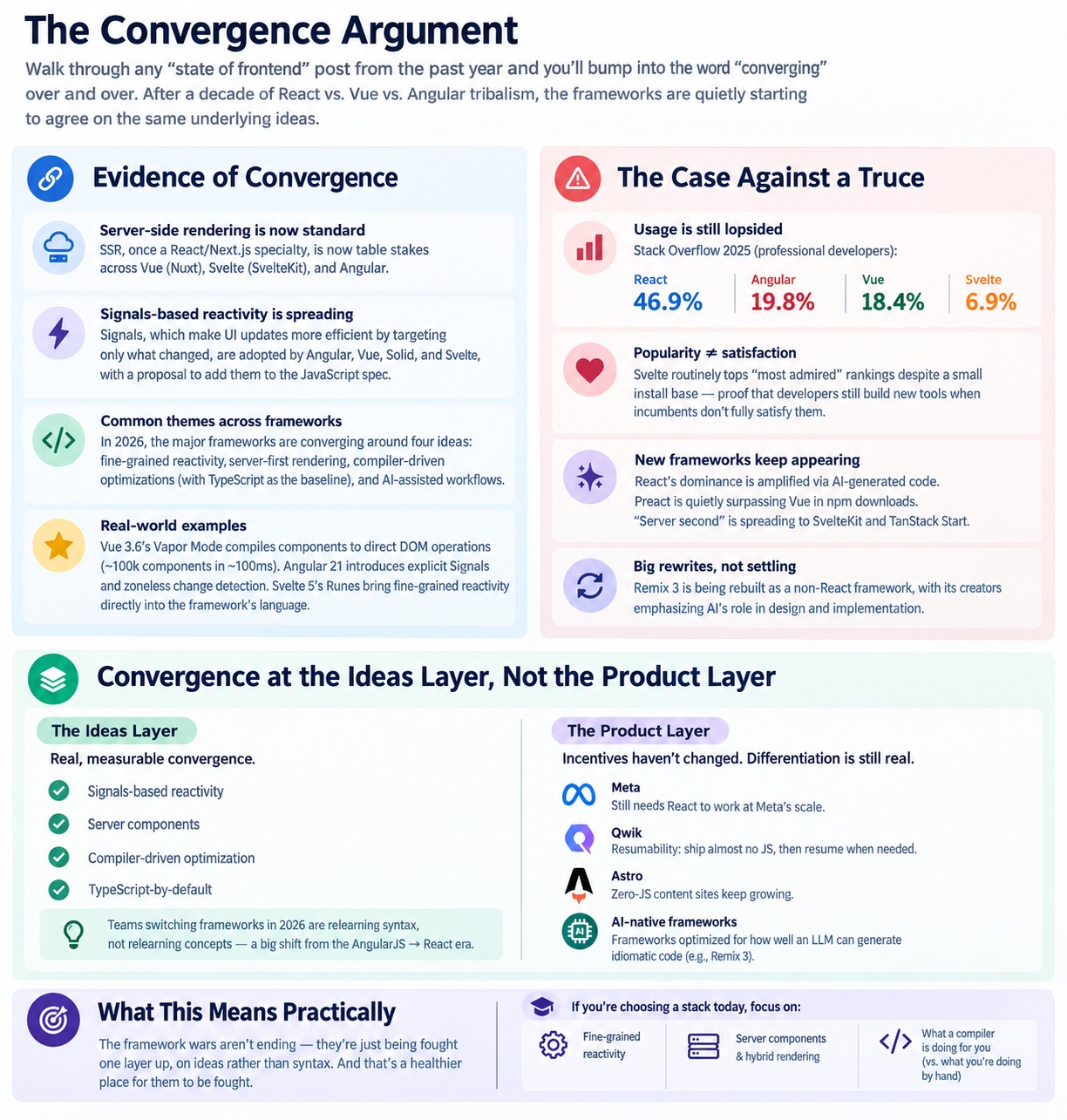
The Convergence Argument
Walk through any "state of frontend" post from the past year and you'll bump into the word "converging" over and over. The claim: after a decade of React vs. Vue vs. Angular tribalism, the frameworks are quietly starting to agree on the same underlying ideas.
There's real evidence for this. Server-side rendering, once a React/Next.js specialty, is now table stakes: server-side rendering, which used to be a React and Next.js specialty, is now standard across Vue (via Nuxt), Svelte (via SvelteKit), and Angular. Even more striking is what's happening with reactivity. A reactivity model called Signals, which makes UI updates more efficient by targeting only the specific elements that changed, has been adopted by Angular, Vue, Solid, and Svelte, with a proposal underway to add it to the JavaScript language specification itself. That last part matters a lot — if signals end up baked into the language rather than living inside individual framework runtimes, it removes one of the biggest reasons frameworks used to feel incompatible with each other.
The pattern extends beyond reactivity. One recent roundup put it bluntly: in 2026 the major JavaScript frameworks are converging around four themes: fine-grained reactivity, server-first rendering, compiler-driven optimizations with TypeScript as the baseline, and AI-assisted workflows. Concretely, that means things like Vue 3.6's Vapor Mode, currently in beta, compiling components to direct DOM operations and demoing around 100,000 components mounting in approximately 100ms, alongside Angular 21 shifting to explicit Signals and zoneless change detection, with zone.js no longer included by default as of v21. Meanwhile Svelte 5's Runes push fine-grained reactivity right into the language of the framework. Different syntax, same destination.
The Case Against a Truce
But before declaring the framework wars over, it's worth noting who's still winning and why fragmentation persists anyway. Usage data hasn't converged at all — it's still lopsided. Stack Overflow's 2025 survey put React usage among professional developers far ahead of the pack, with React at 46.9%, Angular at 19.8%, Vue at 18.4%, and Svelte at 6.9%. And popularity doesn't track satisfaction: Svelte routinely tops "most admired" rankings despite a small install base, which tells you people keep building new tools precisely because incumbents don't fully satisfy developers even while dominating hiring.
New frameworks also haven't stopped appearing — they've just changed shape. Ryan Carniato's well-known annual retrospective on the ecosystem notes that React's continued dominance is being amplified via AI-generated code, Preact is quietly surpassing Vue in npm downloads, and the "server second" architecture is proliferating to SvelteKit and TanStack Start. And it's not just incremental tuning — Remix, one of the more established React-based meta-frameworks, is being rebuilt as something else entirely. As one write-up describes it, Remix 3, no longer built on React, is a ground-up rethinking of full-stack web development, with creators Ryan Florence and Michael Jackson vocal about AI's role in both designing and implementing the framework. That's not the behavior of an ecosystem settling down; it's a sign that people still think there's room for a fundamentally different architecture.
Convergence at the Ideas Layer, Not the Product Layer
My read is that both camps are half right, because they're talking about different layers of the stack. At the level of ideas — signals-based reactivity, server components, compiler-driven optimization, TypeScript-by-default — there's genuine, measurable convergence. Teams switching frameworks in 2026 are relearning syntax, not relearning concepts, and that's a real change from the AngularJS-to-React era when the mental models themselves were incompatible.
But at the level of products, nothing about the incentives has changed. Meta still needs React to work for Meta's scale. Someone still wants an app that ships almost no JavaScript, which is why Qwik's resumability model exists at all — Qwik's core idea of "resumability" attempts to rethink how web apps are delivered to browsers, shipping almost no JS initially and then resuming execution when needed. Someone still wants zero-JS content sites, which is why Astro keeps growing. And now AI-assisted coding is introducing a whole new axis of differentiation — frameworks optimized for how well an LLM can generate idiomatic code in them, which is explicitly what's motivating projects like Remix 3.
So I don't think 2026 is the year the JS framework landscape "converges" into two or three tools. I think it's the year the vocabulary converges enough that switching costs quietly drop, while the list of names you have to know stays just as long — maybe longer, once you count the AI-native rewrites. Framework fatigue isn't disappearing; it's just easier to live with, since framework lock-in is decreasing as frameworks converge, and hiring gets more flexible because a strong developer who knows one framework deeply can ramp up on another project faster than before.
What This Means Practically
If you're choosing a stack today, I'd weight architectural fundamentals over brand loyalty: understand fine-grained reactivity, understand server components and hybrid rendering, understand what a compiler is doing for you versus what you're doing by hand. Those skills transfer even as the specific framework names on your resume change every couple of years. The framework wars aren't ending — they're just being fought one layer up, on ideas rather than syntax, which honestly is a much healthier place for them to be fought.